
Online Presence: A Guide for Service Pros
Whether you’re starting out or already established, an online presence is critical. This article breaks down the digital marketing basics, defining your ideal client, crafting a website that converts, and a social media post strategy that attracts the right clients.
The Foundation
Understanding your target market is crucial for effective marketing. Marketing to everyone often means marketing to no one. Therefore, the first and most important step is to identify your target market, specific segments of the broader market where you will focus your marketing efforts.
For example, consider a personal trainer. While they may offer general fitness training, focusing on a niche like “personal trainer for busy moms to maintain a healthy figure” is better than “personal trainer for weight loss” and can make a significant difference.
The more specific your niche, the better, as these clients will likely be willing to pay more because they see you as someone who truly understands their unique challenges and can provide tailored solutions. This does not mean you have to limit your services to only these clients or alter your core offering, especially in the early stages. However, identifying your ideal client profile helps guide your marketing efforts.
To pinpoint your target audience, consider the following questions:
- Are they going to be easy to work with?
- Do they value this service? Are they willing to pay a lot of money for it?
- How valuable or profitable is this service for them?
- What keeps them awake at night?
- What are they afraid of?
- Who are they angry at?
- What are their top daily frustrations?
- What trends are occurring and will occur in their businesses or lives?
- What do they secretly, ardently desire most?
- What’s the main dominant emotion this market feels?
- What is the ONE thing they crave above all else?
Finding the “Why” (The 5 Whys)
Don’t just assume you know what the problem is. To truly understand your target market, ask “why” five times to uncover the root cause of their issues. Engaging directly with clients can provide even deeper insights into their challenges and needs.
Compile detailed profiles for your target audience, including:
- Location and demographics
- Values, desires, and goals
- Problems and interests
Your target audience profile serves as the foundation for all your marketing efforts.
Your Owned Digital Assets
You attract new prospects through various channels such as recommendations from previous clients, social media posts, and paid advertising. However, it’s crucial to understand that these channels are not permanent.
Social media, for instance, is a rented space where you don’t have control over changes in features or the ability to consistently reach your audience. To ensure your audience can find you reliably, you need to drive them to something you own.
The best way to do this is through your own website and a mailing list. These are your owned digital assets that provide a stable and reliable way for prospects to find and engage with you. Even if people hear about you through word of mouth, most will still look you up online before reaching out.
The Role of an Effective Website
I believe a website for a service business has a vital, but often misunderstood, role. It’s not about creating demand from scratch. It’s about protecting the demand you already have and making sure your best prospects choose you. In other words, it helps the people who are already interested in your business take the next step, rather than hoping the website alone will find new clients.
Think of your website as a safety net that prevents interested prospects from falling through the cracks. It’s about patching holes in a bucket, rather than pouring more water in. Your website should:
- Clearly explain what you do
- Identify who it is for
- Describe how you approach problems
- Give prospects a sense of what working with you feels like
By the time a prospect reaches out, they should no longer be a stranger. They should understand your expertise and feel confident about talking to you.
How to Increase Conversions with Your Website
People hire people they trust. Your website is a prime opportunity to build that trust.
It should:
- Demonstrate your expertise
- Show that you understand their problems
- Feel calm, competent, and considered
This can be achieved by showcasing case studies, testimonials, and the great results you’ve achieved for your best clients. When a site communicates clearly and thoughtfully, prospects feel more comfortable taking the next step.
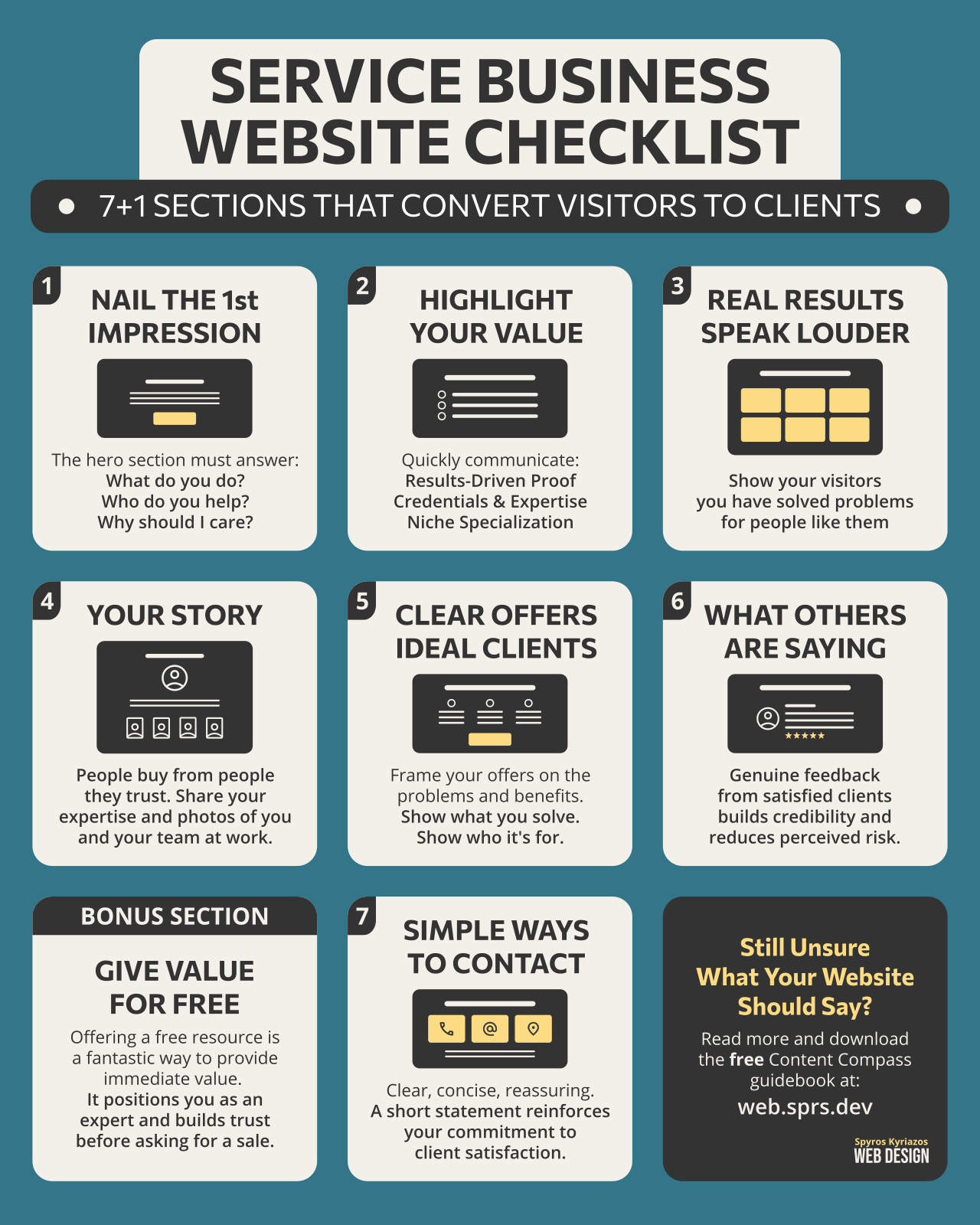
For more detailed guidance on website layout and content, you can refer to this in-depth post: The Strategy Behind a High-Converting Site
I also offer a free guided questionnaire that can help you uncover your strongest selling points and turn them into a clear, professional online presence that attracts better clients. You can download and fill it out at your own leisure from here:
The Content Compass →
Define Your Core Offering
Creating an irresistible offer helps you stand out in a crowded market and attracts the right clients who are most likely to benefit from your services. A compelling offer not only highlights the unique value you provide but also addresses the specific pain points of your target market.
Here are some key questions to consider when defining your core offering:
- What problem are you sure you could solve for a member of your target market?
- If you only got paid if the client achieved their desired result, what product or service would you offer?
- Of all the products and services you offer, which do you enjoy delivering the most?
- What’s the biggest benefit to lead with?
- What objections do your prospects have, and how will you solve them?
- If you are confident about your results, include guarantees to prove it.
You’ll use this information when creating your services section on your website, a dedicated landing page for a specific offer, social media posts, or advertisements.
How People Find You
This will act as your social media posting guide. Educate, consult, and advise instead of selling. The key is to provide value to your audience consistently, which will naturally lead to increased engagement and conversions.
Define Your Real Goals
Determine what your primary focus is for social media engagement. For small businesses, “Brand Awareness” can often be a costly endeavor that doesn’t yield immediate results. Instead, pivot your focus to:
- Lead Generation: Attract potential customers who are actively seeking your services.
- Customer Engagement: Build authentic relationships and foster a sense of community among your audience.
The Golden Rule: Regardless of your goal, your content must help selflessly. Provide genuine value to your audience without always pushing your services.
The “Value-Add” Loop
Consider what are the necessary steps clients must take before and after your services for a comprehensive solution to their problem. Your post strategy should focus on creating content that solves one tiny, specific piece of this journey. This approach helps you address specific needs and build trust over time.
The 9/1 Rule:
- 9 posts should provide genuine value.
- 1 post should include an offer with a compelling call-to-action (CTA).
This strategy leverages the Law of Reciprocity: prospects are more inclined to reciprocate when they receive something truly useful for free.
Sustainable Execution
Don’t try to be everywhere and do everything. You will quickly burn out and give up. Here are the steps to ensure sustainable execution:
- Pick ONE Platform: Focus on a single platform where your target audience is most active.
- Research Post Types: Identify the types of posts that perform well on your chosen platform (e.g., images, videos, text posts, infographics).
- Be Realistic: Choose formats you can produce consistently without putting a burden on the rest of your work.
- Consistency over Intensity: Posting twice a week for a year is more effective than posting every day for two weeks.
This strategy isn’t about going viral, it’s about building authority and trust with your specific target audience. What’s one small win you can give them today?
Testimonials and Word of Mouth
Testimonials are gold. Genuine feedback from satisfied clients builds credibility and reduces perceived risk.
For your website, include:
- Full Testimonials: Not just a star rating, but a detailed statement to showcase the problem solved or the customer experience.
- Client Details: Name, role, and ideally a photo. This increases credibility by proving there is a real person like them behind the statement.
Asking for testimonials can seem daunting, so here are some tips to make the process smooth and effective:
- Ask at the Right Time: Request testimonials after you’ve delivered a successful project or service. This ensures that your clients have experienced the full value of your work.
- Be Specific: Ask for detailed feedback rather than just a general statement. For example, instead of asking, “How would you rate our service?” ask, “What specific challenges did we help you solve, and how did our service make a difference?”
- Make It Easy: Provide a simple form or template for clients to fill out. This reduces the barrier to giving feedback and ensures you get the information you need.
- Show Appreciation: Thank your clients for their time and effort. Let them know how much you value their feedback and how it helps others understand the impact of your services.
If you offer services in a specific local area or in-person, utilize a Google Maps listing. This can help potential clients find you easily and leave reviews, which are valuable for building credibility. You can pick the best ones to showcase as testimonials on your site afterward.
More Ways to Convert Visitors to Clients
The fact remains that less than 10% of visitors will buy on their first visit to your website. You need a way for them to remember you after they leave.
Lead Magnet
A lead magnet is something useful that encourages visitors to return or prepares them for the next step before your service. Offering a free resource, such as a checklist, guide, or template, is a fantastic way to provide immediate value. This positions you as an expert and builds trust before asking for a sale.
Low-commitment downloads are ideal for visitors who are not yet ready to inquire about your services. When they are ready to proceed, they are more likely to remember you instead of your competitors because you have already solved a problem for them.
Mailing List Subscriptions
To boost mailing list subscriptions, offer something of ongoing value. For example, if your clients need to prepare for a service, you could create a series like “How to Prepare for X in 30 Days.” Visitors can subscribe to the mailing list and receive their next step in a timely manner.
If your clients might need your services more than once, consider offering weekly tips about maintaining X. This keeps you top-of-mind and provides consistent value.
Use the same principles about providing value that I mentioned in the social media section. Create content that addresses the specific needs of your target audience and offers solutions to their problems.
The more you work in your business and with your clients, the more stories, tips, and content you will collect. These can be turned into valuable assets like lead magnets, social media posts, or blog articles.
Additional Tips
Do you need a blog?
A blog section on your website is nice to have, as it improves SEO, but don’t force yourself to create one from the start. If you follow my recommendations of providing value often through social media and your mailing list, you’ll soon accumulate enough material to create some blog posts. Blogging can be a natural extension of your content strategy once you have a steady flow of ideas and insights.
Waiting List
Show your availability and demand by maintaining a waiting list. Highlight how many slots you have left and that others are waiting for your services too. You can do this in response emails or calls or when posting offers on social media.
For example, “I currently have x active clients, so I’ll be able to focus on you starting on [specific date]. In the meantime, you can join my waiting list, download some of my free resources to get started, or follow me on social media to stay updated and prepare for our session.”
Or for an offer post: “We are taking on exactly 4 new clients this month to ensure personalized, high-quality work. Don’t miss your chance to secure your place.”
Conclusion
That might seem like a lot, but you don’t have to do it all at once. Start with the strong foundations of defining your target audience, creating your core offer, and planning your website content. For your social media presence, consistency beats intensity. It takes time to build even a small following, so make sure to work at it but at a pace you won’t burn out.
P.S.: Occasionally, I post useful tips on my LinkedIn page. If you want more tips, you can follow the page here and read the existing posts.